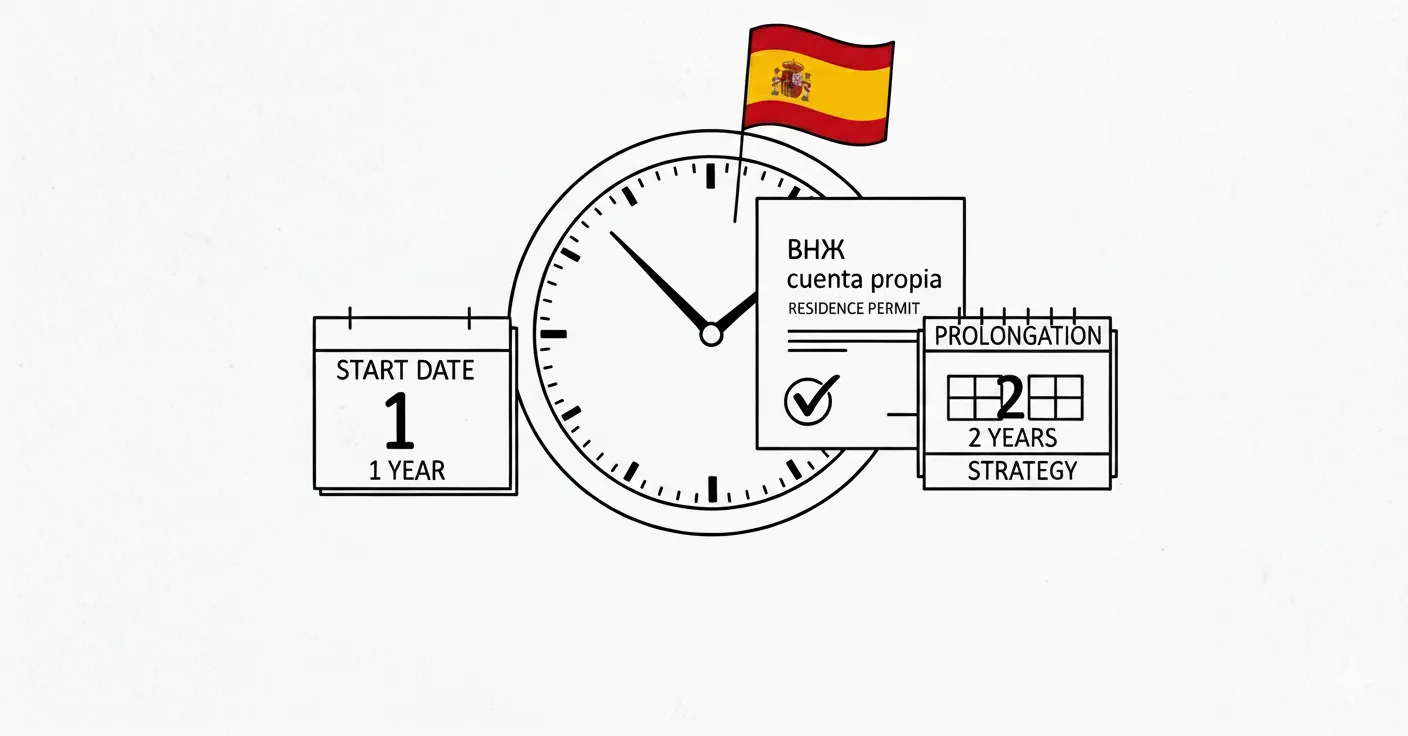

What Is the Residencia y Trabajo por Cuenta Propia?
The Residencia y Trabajo por Cuenta Propia is a residence and self-employment permit in Spain. It allows foreign nationals to work as self-employed individuals (autónomo) or to establish their own company (e.g., an SL – Sociedad Limitada) without the need for an employment contract with a Spanish employer.
Key Benefits of the Self-employed Residence Permit
Low income requirements
There are no formally fixed income thresholds; however, monthly revenue of approximately €1,500 is generally considered sufficient.Independence from an employer
You can work for yourself without being tied to an employment contract.Possibility of renewal and permanent residence
Provided that the requirements are met, the permit can be renewed and may eventually lead to long-term (permanent) residence.Family reunification
Family members may modify their status together with the main applicant (although in some cases they may be required to leave Spain and apply from abroad).
Who Is Eligible?
This type of residence permit may be requested by foreign nationals who are already legally residing in Spain, including:
Language course students (until May 20, 2025) and students enrolled in higher or vocational education
Digital nomads (the previous limitation requiring Spanish-source income to not exceed 20% is removed)
Holders of an Entrepreneur Residence Permit (startup visa)
Residents holding a Non-Lucrative Residence Permit (without the right to work)
Permitted Activities: Any lawful business activity, including services, trade, or manufacturing.
Duration of a Self-employed Residence Permit
Initial Residence – 1 Year
A one-year initial residence permit is granted in the following cases:
First-time application submitted through a Spanish consulate in the applicant’s country of origin
Modification from a student residence permit (higher or secondary education) after completing studies
Modification from a language course student permit issued before May 20, 2025, after completing studies
Modification from a Non-Lucrative Residence Permit after one year of residence in Spain (the authorization becomes effective once the applicant registers with the Spanish Social Security system – Seguridad Social)
Extended Residence – 4 Years
A four-year residence authorization may be granted when modifying from a residence permit that already includes work authorization (e.g., Digital Nomad, Highly Qualified Professional, Startup/Entrepreneur permit, etc.) after one year of legal residence in Spain.
Main Requirements for Obtaining a Self-employed Residence Permit
1. Legal Stay and Personal Eligibility
These requirements determine the applicant’s legal status and eligibility. The applicant must:
Be over 18 years old at the time of application
Not be a citizen of an EU, EEA country, or Switzerland
Not be listed as inadmissible to Spain or other EU countries
Have no criminal record in Spain or in any country of residence during the past five years
Be legally present in Spain at the time of application
2. Professional Qualifications and Business Viability
The applicant must demonstrate that they possess the necessary knowledge, qualifications, and experience to carry out the proposed professional activity in Spain.
The following documents must be provided:
Proof of relevant education (university or secondary diplomas, course completion certificates, professional training certificates) or proof of professional experience in the relevant field (employment references, employment records, contracts with clients for related services)
A business plan demonstrating the viability and profitability of the proposed activity. The business plan serves as a key document for the Spanish immigration authorities when deciding whether to grant the Self-employed Residence Permit.
3. Financial Capacity
The applicant must prove sufficient financial resources to:
Launch the business activity
Support themselves (and their family members, if applicable)
Generate sustainable income without placing a burden on the Spanish social system
Funds Required to Start the Business
The applicant must demonstrate sufficient funds in a bank account to cover expenses related to starting the professional activity, including:
Business registration
Premises rental (if applicable)
Equipment, tools, and software
Initial operating expenses
There is no fixed minimum amount. The required level of funds is assessed in relation to the specific type of activity and the submitted business plan.
Funds for Living Expenses (Applicant and Family Members)
The applicant must demonstrate sufficient financial means to reside in Spain for the duration of the permit (minimum one year).
The law does not establish fixed amounts. However, in practice, it is advisable to show funds exceeding the minimum subsistence threshold:
Main applicant — approximately €8,000
Each additional family member — approximately €3,000–€4,000
Expected Business Income
Projected income must be clearly reflected in the business plan and demonstrate the economic viability of the project.
There are no formally established minimum income thresholds. However, in practice, it is advisable to show projected net profit at or above the Spanish minimum wage (approximately €1,500 per month).
4. Compliance with Spanish Regulations
The proposed activity must comply with Spanish legal requirements.
If the activity is subject to licensing, the applicant must demonstrate either possession of or the ability to obtain the necessary licenses and permits.
If opening premises accessible to the public (shop, office, restaurant, etc.), a business opening license (licencia de apertura) issued by the local municipality is typically required to confirm compliance with sanitary and technical regulations.
If the activity is not subject to licensing, no additional permits are required.
In practice, it is often advisable to structure the business model in the business plan in a way that avoids licensing requirements, where legally permissible.
List of Documents for Self-employed Residence Permit Application
All documents must be translated into Spanish and submitted electronically online (sworn translations + scanned copies of the originals).
Certain documents require a📍 jurada translation, meaning an official Spanish translation prepared and certified by a sworn translator registered in Spain.
General Documents
Valid passport / TIE (Foreigner Identity Card)
Proof of sufficient financial means: bank certificates or bank statements showing the available balance
Business plan prepared in accordance with the applicable requirements
Proof of relevant education: secondary or university diplomas (📍jurado translation + apostille), certificates of additional education and completed courses (📍jurado translation)
Proof of professional experience: employment record book, employment references, contracts with clients for relevant services (required if the applicant does not have formal education in the field) (📍jurado translation)
CV and professional portfolio (personal website, social media links, or project samples)
Proof of a workspace for conducting the activity: lease agreement (or pre-contract) for office premises or workspace
Proof of interest from potential clients: letters of intent, pre-contracts, or a preliminary client list
Receipt confirming payment of the residence permit government fee — TASA modelo 790, código 052 (approx. €10)
Receipt confirming payment of the work authorization fee — TASA modelo 790, código 062
approx. €80 (in case of modification)
approx. €200 (for an initial residence application)
Supporting Documents (Recommended)
These documents may strengthen the application:
Business plan approval certificate issued by an authorized professional association (such as ATA, UPTA, or similar organizations), confirming the viability of the project
Proof of startup-related expenses: invoices and payment receipts for materials, equipment, or professional services
Additional Documents for Students
Certificate of completion of studies (required for applicants modifying a student residence permit — estancia por estudios — to a self-employment residence permit)
DELE or SIELE Spanish language exam certificate (required in certain regions)
Additional Documents for Applicants Already Registered as Self-Employed (Autónomos)
Alta en el RETA — Registration in the Special Self-Employed Social Security Regime
Alta Censal en Hacienda (Modelo 036) — Tax registration (Form 036)
Updated Certificado AEAT — Certificate from the Spanish Tax Agency confirming no outstanding tax debts
Updated Certificado TGSS — Certificate from the General Social Security Treasury confirming no outstanding social security debts
Informe de Vida Laboral — Employment history report
Tax declarations from previous periods — Modelo 130
Business Plan as the Foundation of the Application
The business plan is the key document demonstrating the viability and profitability of the proposed activity. It serves as the basis for the decision of the Spanish immigration authorities on whether to grant a por cuenta propia residence permit.
Mandatory Elements of the Business Plan
Description of the activity: detailed explanation of the proposed business activity and your professional background.
Marketing and promotion strategy: clear description of how your services will be promoted (website, social media, advertising channels, etc.).
Market analysis: assessment of competitors, target audience, and market opportunities.
Financial projections: revenue and expense forecasts, including startup investment, expected profit, planned reinvestment, taxes, and social security contributions.
Business plan verification: it is strongly recommended to have the business plan reviewed and approved by an authorized organization such as ATA (Asociación de Trabajadores Autónomos) or UPTA (Unión de Profesionales y Trabajadores Autónomos). While not legally required, this significantly increases the chances of approval.
Application Procedure for a Self-employed Residence Permit
When You Can Apply
Students: from two months before the expiration of their current residence permit and up to three months after completing their studies. Application is not possible before completing the studies.
Applicants holding another type of residence permit: may apply during the validity period of their current residence authorization.
Processing Time
The official processing time is up to three months. In practice, it may range from two to eight months depending on the region.
If no decision is issued within the official period, the principle of “negative administrative silence” (denegación por silencio administrativo) applies. However, it is advisable to wait for the formal decision, as it may still be positive.
If the previous residence permit expires during the review process, the applicant remains legally in Spain until a decision is issued.
Regional Considerations
Valencia: stricter approach, high volume of applications, higher risk of refusal—especially if the business plan is weak.
Barcelona (Catalonia): processing may take additional time (up to one extra month), but authorities tend to be more flexible.
Spanish autonomous communities may interpret regulations differently, which can affect approval rates.
Preparing for Submission
Before filing the application, it is advisable to fully prepare the business infrastructure:
Sign a lease agreement (if premises are required)
Obtain necessary licenses and permits (if applicable)
Set up a website and marketing materials
Collect proof of investment (invoices, receipts, contracts)
Financial and Legal Aspects
Taxes and Social Security Contributions
If the applicant is not yet registered as autónomo at the time of application, after approval they must:
Register as self-employed
Enroll in the Spanish Social Security system
Begin paying monthly social security contributions
During the first year, the reduced rate is approximately €86 per month, after which contributions increase progressively depending on income.
Tax Obligations
The applicant becomes a Spanish tax resident and must declare worldwide income.
Main taxes include:
Progressive personal income tax (IRPF) ranging from 19% to 47%
Value Added Tax (VAT) at 21% (for clients located in Spain)
VAT generally applies:
To most business activities (with limited exceptions)
Regardless of revenue level (unlike some other jurisdictions)
Restrictions After Approval
Initial Residence
Work is limited to the region where the permit was granted (irrelevant for fully online activity).
Work is limited to the declared field of activity.
These restrictions are lifted after renewal.
If the permit is granted directly for four years (modification from certain categories), these restrictions do not apply.
Registration as autónomo (or incorporation of an SL company) and enrollment in Social Security are mandatory.
Renewal of the Self-employed Residence Permit
Validity Period
Initial validity: 1 year, 2 years, or until the expiration of the previous permit (depending on regional practice).
After the first year, the permit may be renewed for four years if requirements are met.
Renewal Requirements
Mandatory:
No outstanding tax or social security debts
Continuous registration as autónomo
In addition:
Business income should generally correspond to the projections in the business plan (or at least exceed the Spanish minimum wage).
In practice, renewals have occasionally been granted even where minimal income was declared, but relying on this is highly risky. It is advisable to declare income consistent with the original projections.
Documents Required for Renewal
Completed application form
Valid passport and copy of current residence card
Proof of continued business activity
Evidence of tax and social security payments
Renewal Procedure
The renewal application must be submitted:
Within 60 days before expiration of the current permit
Or within 90 days after expiration (late filing may result in fines)
Maximum processing time: three months.
If no decision is issued within this period, the application is considered automatically approved (silencio administrativo positivo).
Rights After Renewal
The holder may work both as an employee and as self-employed
Work is permitted throughout all regions of Spain
Modification of Residence Permits for Family Members
Who Is Affected?
Family members of applicants under Law 14/2013 (digital nomads, entrepreneurs/startups, investors, highly qualified professionals, researchers, etc.) hold dependent residence permits.
When the main applicant changes status, their family members must also modify their residence status.
Possible Modification Pathways
Individual Modification
If a spouse or adult child is already working in Spain, they may independently modify their residence permit (including switching to an independent Self-employed Residence Permit).
Family Reunification Within Spain
As of August 2025, family reunification within Spain is available for:
Family members of students
Family members under Law 14/2013 (digital nomads, startups, etc.)
Digital Nomads (and similar Law 14/2013 categories)
If the main applicant switches to Self-employed Residence Permit, family members may apply after the main file is formally accepted for processing.
If a family member applies independently, a minor child may join, while the second adult’s pathway may require consular processing (practice still evolving).
Students
If a student applies for Self-employed Residence Permit, family members may apply simultaneously.
A dependent family member of a student cannot independently switch to cuenta propia.
Application from Russia (or Other Home Country)
If applying from abroad for an initial Self-employed Residence Permit, family reunification is generally possible only after one year.
Practical Scenarios
If the main applicant applies for Self-employed Residence, their family may apply for reunification from within Spain together with the main applicant.
If reunification is refused, the process must be carried out via the Spanish consulate abroad, which may involve:
Leaving Spain for an extended period
Interrupting the residency period required for long-term residence eligibility
Although current practice is not yet fully consistent, there are strong arguments that future administrative practice should become more flexible, as refusals are often procedural rather than substantive.
Requirements for Family Reunification
Minor children must attend school in Spain. Enrollment in foreign online schools not registered in Spain may result in refusal.
Family members must share official registration (empadronamiento) with the main applicant. Separate registration or residence at a different address may lead to refusal of renewal or modification for the entire family.
Required Documents for Family Reunification
General documents
Main Applicant
Valid passport (scan of all pages)
TIE card (Foreigner Identity Card)
Reuniting Family Members (for each applicant)
Valid passport (scan of all pages)
TIE card
Completed application form EX-02
Proof of payment of government fee — TASA modelo 790, código 052 (2.1.2 – Temporary residence for family reunification)
Financial Requirements
Bank statements must demonstrate sufficient financial means.The required amount is 50% of the IPREM per family member (approximately €4,200 per person).
For example:
Family of 2 (applicant + spouse): €8,400 + €4,200 = approx. €12,600
Family of 3: approx. €16,800
And so on.
Civil Status Documents
Marriage certificate or registration of pareja de hecho (registered partnership)
Additional Documents for Children:
Birth certificate (apostilled + sworn translation into Spanish)
Notarized consent from the other parent authorizing residence in Spain (apostilled + sworn translation), if the parents are not currently married
Informe de adecuación de la vivienda
The application may be submitted online (via the local municipality’s website) or in person.
2. Indicative List of Documents (may vary by province)
Lease agreement or proof of property ownership
Proof of payment of the relevant fee
Joint municipal registration (empadronamiento)
Authorities will review the documents and schedule a housing inspection.
If the housing conditions are deemed adequate, an “Informe de Adecuación de la Vivienda” (Housing Adequacy Report) is issued — typically within approximately one month after inspection.
If the Main Applicant Is Already Registered as Self-Employed (Autónomo):
Certificate from AEAT confirming no outstanding tax debts
Certificate from TGSS confirming no outstanding social security debts
Annual personal income tax return (IRPF – Modelo 100)
Recent quarterly tax returns (Modelo 130 and/or Modelo 303)
Vida Laboral (employment history report)
General Recommendations
Avoid Declaring Excessively High Business Income
On the one hand, unusually high projected income may raise concerns with the reviewing officer.
On the other hand, during renewal, authorities may question why the projected taxes were not paid in line with the initial forecast.
It is advisable to keep financial projections realistic and well-justified.
2. Be Cautious with Hiring Plans in the Business Plan
Do not overcomplicate the project by including unnecessary staff.
If hiring employees is logically required for the business model, that is perfectly acceptable.
However, it is not mandatory.
A practical strategy is to reflect potential hiring plans in the second year of activity, which may help avoid additional questions at the renewal stage.
The More Funds Demonstrated, the Better
Showing a higher bank balance strengthens the financial credibility of the application.
4. Letters of Intent Are Important
Letters of intent or pre-contracts significantly strengthen the application.
It is advisable to provide at least five, where possible.
If relevant to your business model, obtaining such letters from Spanish limited companies (SL) may further reinforce the file.
Demonstrate Investment in the Business
Even for an online business, it is advisable to show tangible startup investment (computer equipment, office furniture, software, etc.).
6. Avoid Highly Regulated or Licensed Activities Where Possible
Entering sectors such as hospitality or other licensed activities is generally not recommended:
More regulatory requirements
More supporting documents
Closer scrutiny from authorities
Whenever possible, it is advisable to structure the business plan around a simpler and less regulated activity.
7. If You Prepare the Business Plan Yourself
All key aspects should be clearly justified directly within the business plan. Do not rely solely on attached supporting documents.
You should clearly explain:
Why the project will succeed
What differentiates you from competitors
Whether you have sufficient financial resources
Whether you have adequate education and/or professional experience to carry out the activity
The reviewing officer should be able to understand the viability of your project solely from reading the business plan.