
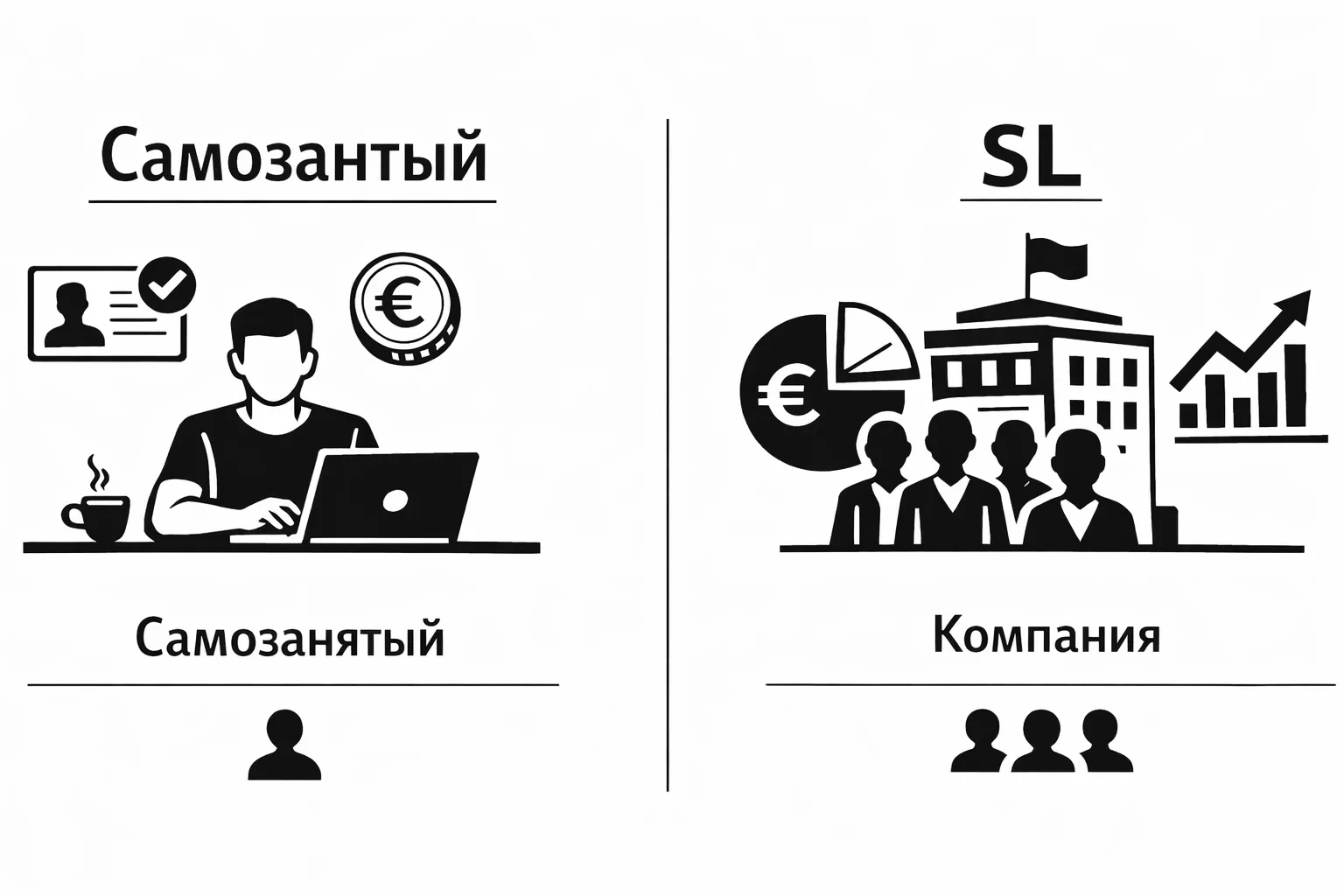
Spain offers foreign entrepreneurs the opportunity to obtain a residence permit through the Residencia y Trabajo por Cuenta Propia program — a permit for residence and self-employment. It allows you to start your own business or work as an independent professional.
The future business can take two forms:
Autónomo — registering in Spain as a self-employed entrepreneur;
Sociedad Limitada (SL) — creating your own company and applying as its administrator or partner.
Both formats are officially recognized but are evaluated according to different criteria. Autónomo is primarily your personal professional activity, whereas SL is considered a corporate project with a separate structure, a more complex financial model, and scalability potential.
Let's examine in detail the key differences, including the most important aspect — the difference in business plans.
1. Legal Status and Level of Liability
In the case of Autónomo, the applicant acts as an individual, works under their own name, and bears personal property liability. This format is suitable for freelancing, individual services, and other types of activities where the business is based on a person's professional skills.
SL, on the contrary, represents a legal entity. Liability is limited to the share capital — this reduces personal risks. The company structure also allows for multiple owners, distribution of shares, introduction of partners, and formation of more complex business models.
2. Taxes and Profit Distribution
For Autónomo, all profit automatically becomes their personal income, subject to IRPF tax on a progressive scale (19–47%). Social contributions typically range from €80 to €500/month, and reporting is quite simple.
In the case of SL, the profit belongs to the company. The owner-administrator can receive money in two ways:
administrator remuneration (retribución propia) — recorded as a company expense and reduces the taxable base
dividends (if there is undistributed profit) — paid only from net profit and subject to IRPF 19–26%.
SL pays corporate income tax (15-25%) + owners pay personal IRPF taxes on their income from the company. Additionally, the administrator must also pay social contributions. As a rule, SL requires accounting support with annual reporting to the Registro Mercantil.
3. Scalability and Development Prospects
Autónomo is ideal for individual professionals who value flexibility, low costs, and minimal bureaucracy.
SL is appropriate for more ambitious projects: with partners, investments, growth, hiring employees, or targeting corporate clients. The ability to have multiple owners makes SL convenient for structuring investments and joint business ventures.
4. Difference in Business Plan for Autónomo and SL
Autónomo: the business plan focuses on the specialist and describes professional qualifications, services, clients, and projected income for 3 years.
SL: the business plan is more complex and corporate. It must describe in detail the company structure, distribution of shares among owners (if there are several), management mechanism, market and competitor analysis, investment needs, as well as development strategy and potential employee hiring.
Autónomo
The financial model must show that:
you can provide yourself with income above the subsistence minimum
the activity is profitable
expenses are acceptable considering future income and the owner's financial savings.
SL
The financial model is significantly more complex:
investment costs are shown
company profit is also projected for 3 years
corporate taxes and owner taxes are calculated
profit distribution options/administrator salary are specified.
Autónomo or SL: What Works in Practice
The vast majority of applicants for cuenta propia residence permits indeed choose the autónomo format — it's simpler and cheaper. However, for projects with partners, investments, or corporate clients, SL may be the optimal choice.
In our practice, there have been cases where we developed business plans for clients specifically for SL, and such cases received approval on par with autónomo.
If you want to understand which option is right for you — contact us for a consultation. We will help evaluate your project and prepare a professional business plan for submission as autónomo or SL.